
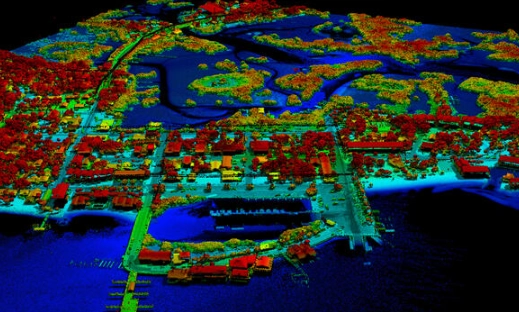

Harness the power of Light Detection and Ranging (LiDAR) technology to generate high-precision, survey-grade 3D data that captures infrastructure environments with unmatched accuracy. PalniES delivers end-to-end LiDAR data processing and analysis—from raw point cloud classification to terrain modeling, feature extraction, and engineering-ready deliverables that support complex infrastructure planning and design.
Using airborne, mobile, terrestrial, and bathymetric LiDAR systems, we process dense point clouds into structured datasets with precise X, Y, and Z coordinates and detailed intensity reflectance values. Our advanced classification workflows overcome the limitations of traditional photogrammetry, enabling accurate modeling of terrain, utilities, transportation corridors, vegetation, and built environments—even in complex or heavily obstructed areas.
PalniES transforms airborne, mobile, and terrestrial LiDAR datasets into structured, engineering-ready spatial intelligence that supports infrastructure planning, design, and asset management. Our team processes raw point clouds through rigorous classification, calibration, and quality-control workflows to produce highly accurate terrain models, surface models, and feature extractions aligned with project specifications and industry standards.
Using advanced LiDAR processing platforms and geospatial analytics tools, we generate classified point clouds, Digital Terrain Models (DTMs), Digital Surface Models (DSMs), breaklines, contours, and 3D feature models with survey-grade precision. Each dataset is validated to ensure spatial consistency and accuracy, enabling seamless integration into GIS, CAD, and BIM environments.
Whether mapping power transmission lines, fiber corridors, highways, rail systems, waterways, or urban infrastructure, our LiDAR specialists deliver scalable spatial intelligence that improves safety, reduces field risk, and supports data-driven decision-making across the project lifecycle.
From large-scale regional mapping to high-resolution site analysis, PalniES transforms raw LiDAR data into accurate, reliable, and actionable spatial models that power smarter infrastructure development.
Airborne, mobile, and terrestrial LIDAR data workflows
Classified point clouds meeting engineering specifications
DTM, DSM, contours, cross-sections, CAD integration
Our LiDAR processing services support a wide range of infrastructure applications, including broadband corridor mapping, transportation planning, utility network analysis, vegetation encroachment assessment, volumetric calculations, and environmental modeling. By converting dense, complex datasets into clean, structured deliverables, PalniES empowers engineering teams to reduce uncertainty, improve design accuracy, and make confident, data-driven decisions.
Automated and manual classification of LiDAR returns into ground, vegetation, buildings, power lines, and custom feature classes per ASPRS standards.
Digital Terrain Model (DTM) and Digital Surface Model (DSM) generation from classified point clouds with custom resolution and accuracy specifications.
3D feature extraction including buildings, roads, utilities, poles, vegetation, and infrastructure assets from LIDAR point clouds to CAD and GIS formats.
Canopy height modeling, tree density mapping, biomass estimation, and vegetation encroachment analysis for forestry and utility corridor management.
Cut/fill calculations, stockpile volumes, site grading analysis, and earthwork quantity takeoffs from LIDAR elevation data.
Combining LIDAR with imagery, GIS data, survey control, and CAD drawings for comprehensive project datasets and multi-source analysis.
A structured approach from requirements to construction-ready deliverables
Raw LIDAR import, trajectory review, density checks

Automated and manual point cloud classification

DTM/DSM creation, contour generation, breaklines

Vector extraction, asset mapping, utility identification

Final outputs in CAD, GIS, and engineering formats

Raw LIDAR import, trajectory review, density checks
Automated and manual point cloud classification
DTM/DSM creation, contour generation, breaklines
Vector extraction, asset mapping, utility identification
Final outputs in CAD, GIS, and engineering formats
High-accuracy terrain data for highway design, transportation planning, and linear infrastructure projects requiring precise elevation and feature mapping.
Power line mapping, vegetation encroachment analysis, pole inventory, and clearance verification for electric utilities and telecom network operators.
High-resolution 3D city models, building footprints, tree inventories, and infrastructure asset mapping for municipal planning and digital twin applications.
Bare-earth terrain models for watershed analysis, flood zone mapping, drainage design, and stormwater management engineering studies.
Don’t let valuable point cloud data sit unused. PalniES converts complex LiDAR datasets into precise terrain models, classified point clouds, contours, and 3D engineering deliverables that integrate seamlessly with GIS, CAD, and BIM workflows.
Our structured processing, validation, and quality-control approach ensures survey-grade accuracy—empowering your teams to design with confidence, reduce field uncertainty, and accelerate infrastructure deployment.